


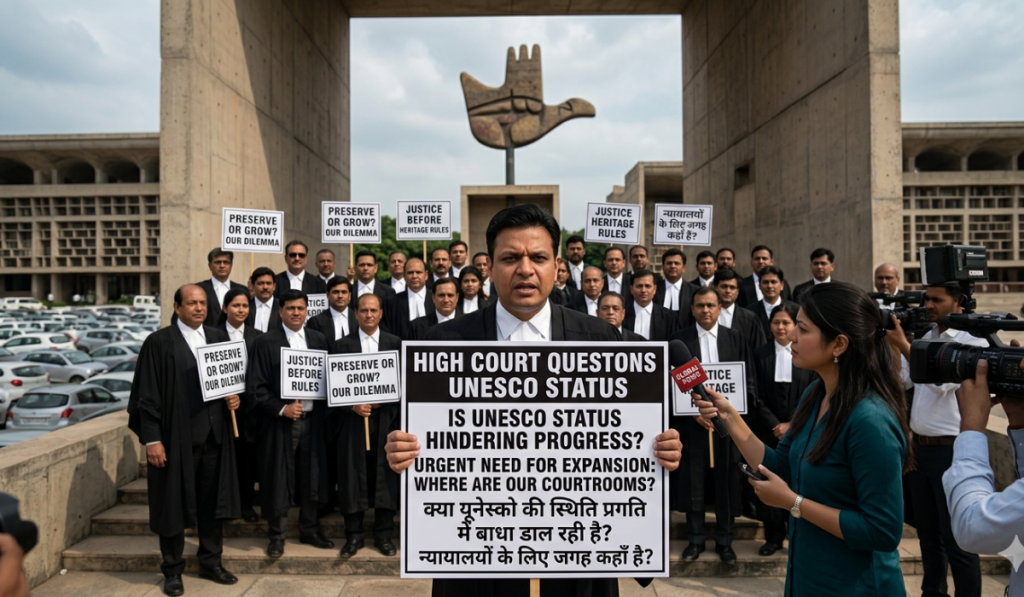
The Punjab and Haryana High Court on Friday raised serious concerns over continuing with the UNESCO World Heritage Site status of Chandigarh’s Capitol Complex. The court asked whether retaining the tag was worth the procedural restrictions and policy limitations affecting its infrastructure expansion. A Bench led by Chief Justice Sheel Nagu suggested that the administration
The Punjab and Haryana High Court on Friday raised serious concerns over continuing with the UNESCO World Heritage Site status of Chandigarh’s Capitol Complex. The court asked whether retaining the tag was worth the procedural restrictions and policy limitations affecting its infrastructure expansion.
A Bench led by Chief Justice Sheel Nagu suggested that the administration should reconsider the status if it hampers the High Court’s development.
Chief Justice Questions Development Constraints
During the hearing, the Chief Justice observed that strict compliance requirements linked to the UNESCO framework were slowing down essential expansion plans.
The court expressed concern that the High Court’s growth was dependent on external approval processes. It questioned why the administration should continue with the heritage status if it restricts much-needed infrastructure development.
Counsel representing the UT Administration informed the court that compliance involves preparing a Heritage Impact Assessment (HIA) and meeting several international conditions. The process, they said, is complex and time-consuming.
Heritage Status and Expansion Challenges
The High Court building, designed by renowned architect Le Corbusier, is part of Chandigarh’s Capitol Complex. The complex holds recognition as a UNESCO World Heritage Site.
Due to this status, any structural change or expansion requires strict review under international heritage guidelines. The administration has already submitted a concept note for the proposed expansion to the Fondation Le Corbusier.
Officials told the court that the proposal has also been forwarded for inclusion in the International Management Plan. This plan is prepared jointly by several member countries under a “transnational serial nomination” process.
Awaiting UNESCO Approval
The UT Administration informed the Bench that once the International Management Plan includes the project, it will be presented to UNESCO for final approval. The decision will also require recommendations from International Council on Monuments and Sites (ICOMOS), which acts as UNESCO’s technical advisor.
However, the Chief Justice asked what would happen if UNESCO rejects the proposal. The administration admitted there is no clear alternative plan in place. The court stressed the need for a “Plan B” in case the expansion does not receive approval.
Court Directs Faster Preparation of Heritage Report
The Bench directed the UT Administration to provide full administrative and financial support to complete the Heritage Impact Assessment at the earliest. The court described the HIA as the most crucial document for securing international approval.
The matter will be heard again on March 7. The court expects a clear timeline for submitting the assessment report.
Infrastructure Shortage in the High Court
The issue arose during the hearing of public interest petitions filed by Vinod Dhatterwal and other petitioners against the Union of India and related authorities.
The High Court has repeatedly highlighted its infrastructure shortage. Although the sanctioned strength stands at 85 judges, only 69 courtrooms are currently functional. The court stated that this shortage prevents it from functioning at full capacity.
Chief Justice Sheel Nagu earlier urged the administration to take a practical approach and approve the comprehensive expansion plan so the High Court can meet growing judicial demands.
Growing Debate Over Development vs Heritage Protection
The case has sparked a broader debate about balancing heritage conservation with judicial infrastructure development in Chandigarh. While the World Heritage tag brings global recognition, the court has questioned whether it should come at the cost of operational efficiency.
As proceedings continue, the final decision may significantly impact the future expansion of one of India’s most important judicial institutions.













Leave a Comment
Your email address will not be published. Required fields are marked with *