


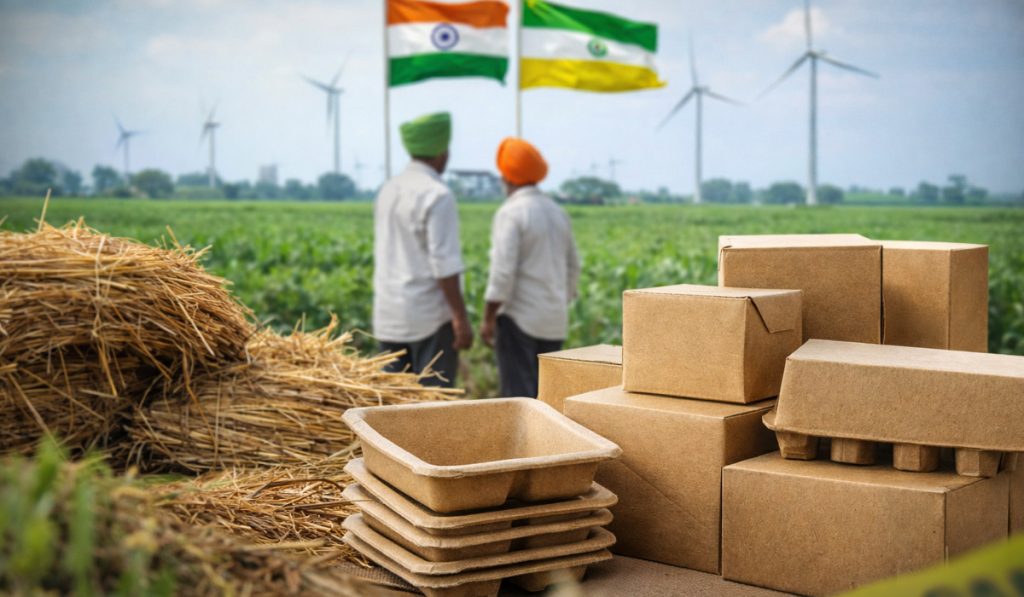
Punjab and Haryana have started their first regional dialogue on building low-carbon packaging using crop residue. The meeting brought together government officials, industry leaders, farmer groups, brands, and sustainability experts. The goal was to understand how agri-fibre pulp and paper can support a circular economy while reducing pollution. Roundtable Highlights Sustainable Packaging Solutions The roundtable,
Punjab and Haryana have started their first regional dialogue on building low-carbon packaging using crop residue. The meeting brought together government officials, industry leaders, farmer groups, brands, and sustainability experts.
The goal was to understand how agri-fibre pulp and paper can support a circular economy while reducing pollution.
Roundtable Highlights Sustainable Packaging Solutions
The roundtable, titled “Building Circular, Low-Carbon Supply Chains for Agri-Fibre Pulp and Paper Packaging,” took place at Hyatt Regency Chandigarh. It was co-presented by Asar and Canopy.
During the discussion, participants explored how paddy straw and wheat straw can become eco-friendly packaging materials. As a result, the dialogue focused on both environmental and economic benefits.
Crop Residue Seen as an Untapped Resource
Punjab and Haryana together produce over 35 million tonnes of crop residue every year. However, much of it is either burned or wasted.
By contrast, experts explained that this residue can support clean air, lower carbon emissions, and extra income for farmers. Moreover, farmers were seen as key partners in circular supply chains.
Punjab Supports Value-Added Use of Residue
Gurmeet Singh Khuddian, Punjab’s Agriculture Minister, said the state is working on sustainable residue management. According to him, such dialogues help link policy, industry, and farmers.
He also said India already has the technology to make pulp and paper from crop residue. Meanwhile, rising demand from e-commerce, FMCG, and retail sectors creates new growth opportunities.
India Shows Strong Production Capacity
India produces around 1.5 million tonnes of agri-residue pulp and paper through 23 mills. Therefore, large-scale production is already possible.
In addition, agri-fibre paper and packaging can reduce dependence on forest-based raw materials.
Haryana Offers Industrial Strength
Shyam Singh Rana, Haryana’s Agriculture Minister, highlighted the state’s strong industrial ecosystem. He said Haryana has clear residue policies and abundant raw material.
Furthermore, the state has pulp and paper hubs in Yamuna Nagar and Panipat, along with growing biofuel infrastructure.
States Can Build a Joint Circular Model
Participants noted that Punjab’s feedstock strength complements Haryana’s processing capacity. Together, the states can build a regional circular bioeconomy.
As a result, this model could reduce stubble burning and connect farmers with industries and markets.
Residue Should Be Treated as a Resource
Vinuta Gopal, CEO of Asar, said crop residue should be viewed as a valuable resource, not waste. She added that smart use can support farmers, protect forests, and lower emissions.
Challenges Need Further Action
However, participants also identified challenges. These include:
-
Weak residue collection systems
-
Low participation of small farmers
-
Poor links between collection and industry
-
Limited policy focus on packaging applications
Low-Carbon Alternatives Gain Importance
Shruti Singh, Country Director of Canopy, said forest-based supply chains face rising climate risks. Therefore, crop residue offers a practical low-carbon option for India.
She added that collaboration is essential to scale circular supply chains.
Next Steps Planned
Finally, participants agreed to continue discussions. They also suggested forming a Punjab–Haryana working group.
Overall, the dialogue marked an important step toward using crop residue for sustainable packaging and placing farmers at the center of the circular economy.














Leave a Comment
Your email address will not be published. Required fields are marked with *